

Laser Diffraction

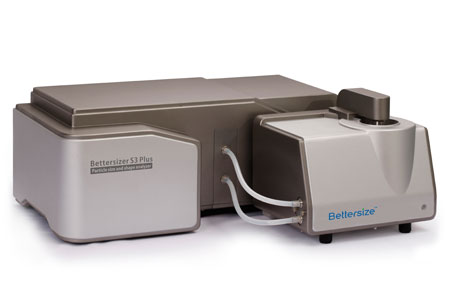
Particle size measurement using static light scattering
The particle size distribution as a parameter to specify a powder or dispersion plays a central role in many applications. Examples are construction material (sands, cements), pharmaceutical development, lime stones, ceramics, colored pigments, fertilizers, emulsions and may more. The range of applications is increasing permanently and hence the requirements on the measurement methods regarding size range, measuring time and reproducibility. Particularly the precise and reproducible detection of particles with sizes close to the measuring range limits as well as the simultaneous determination of particle sizes of very small particles (nanometer range) as well as large particles (lower millimeter range) for the characterization of polymodally or very broadly distributed samples provides a challenge. State-of-the-art laser diffractiondevices such as the Bettersizer S3 Plus solve these tasks by an innovative design of the optical bench for the detection of backscattered light of very small particles and by detecting large particles by an integrated high-speed CCD camera or the combination of static light scattering and Automated Imaging.
Measuring method
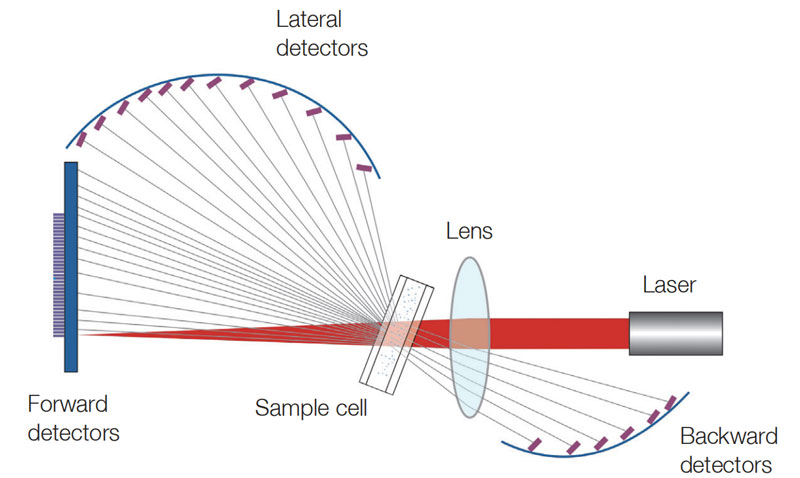
In static light scattering laser light (monochromatic, coherent light) interacts with the particles, which have to be characterized in terms of particle size. In dependence of the particles'size, the light waves are scattered by the particles in a characteristic manner: the larger the particles are, the greater is the scattering in forward direction. With particles smaller about 100 nm, the scattering intensity is nearly identical in all directions.
The scattering intensity is determined by stationary detectors depending on the angle (light scattering intensity distribution). State-of-the-art laser diffraction systems such as the Bettersizer S3 Plus guarantee the determination of scattering intensities in a continuous angular range of 0.02 – 165°, i. e. in forward, side and backward direction. This is achieved by means of a so-called double lens design and oblique incidence optical system (DLOIOS technology): Fourier lenses (collective lens) are positioned between the laser and particles as well as between particles and detectors. The particles will interact with the light within a parallel laser beam. This offers the advantage that the scattered light can also be detected at very large angles (in backward scattering direction) and thus even very small particles can be measured precisely. Thanks to DLOIOS technology, the problems of conventional measurement setups can also be avoided. Therefore, neither the suitable lenses for the corresponding particle size measurement range have to be selected prior to the measurement (in comparison to the Fourier optics), nor do measurement inaccuracies result from different particle to detector distances, if not all particles lie in one plane (in comparison to the inverse Fourier optics).
To calculate the particle size distribution from the measured scattering spectra, the theory of either FRAUNHOFER or MIE is applied. The FRAUNHOFER theory is based on the hypothesis of opaque and spherical particles: the scattered pattern corresponds to a thin opaque two-dimensional plate – diffraction only occurs at the edges. Therefore no additional optical input constants of the material are necessary for this calculation. However, this theory is only suitable for mean particle sizes from approx. 5 µm.
In contrast the MIE theory uses the hypothesis of virtually translucent and spherical particles, meaning that the light permeates the matter and is scattered elastically at the atoms of the particle. The knowledge of the complex refractive index of the particles and the liquid as well is necessary. This theory is applicable for particles of all sizes.
The following figure shows an example of a volume-related particle size distribution of a calcium carbonate powder – measured with a Bettersizer S3 Plus.
The cumulative throughput curve Q3 (blue) and the resulting histogram (q3, black bar) can be seen.
Literature and norms
ISO 13320 – Particle size analysis – Laser diffraction methods
As an particle size analyzer suppliers,Bettersizeis striving to offer you various particle size analyzerwith high quality,such as this laser diffraction particle size analysis.
在线联系供应商
Other supplier products
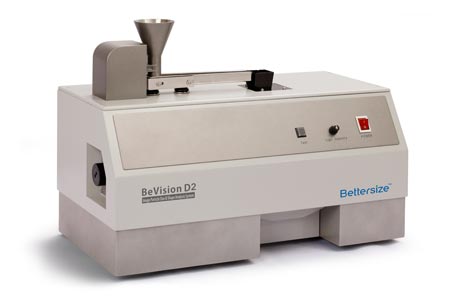 |
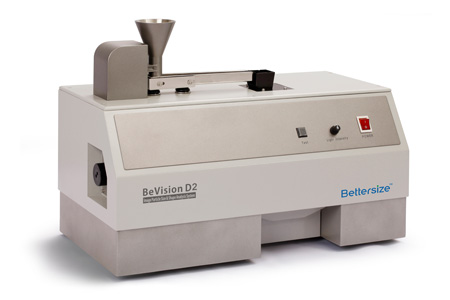
BeVision D2 | Dynamic Particle Image Analyzerwith Dry Dispersion The BeVision D2 particle image analyzer (particle shape analyzer) is a microscopic dynamic im... |
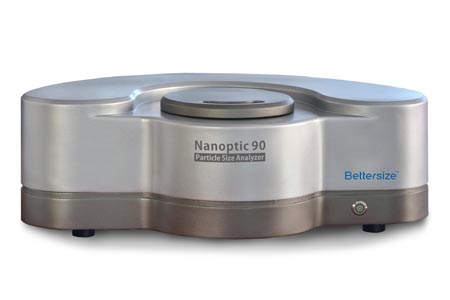 |
Nanoptic 90 | Nano-particle Size Analyzer Nanoptic 90 is a based on the well-known technique of dynamic light scattering (DLS). Nanoptic 90 can measure nano mate... |
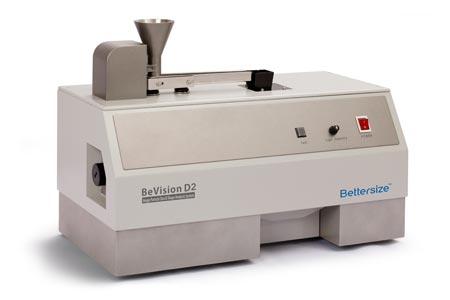 |
BeVision D2 | BeVision D2 Image Analyzer Grain SizeAnalyzerwith Dry Dispersion The BeVision D2 particle image analyzer(particle shape analyzer) is a microsco... |
 |
Dynamic Image Analysis | Most particle size measurement techniquesare based on the assumption of spherical shaped particles. This hypothesis leads to significant errors in ... |
 |
Bettersizer 2600 | Laser Particle Size Analyzer(Dry & Wet Dispersions) The integrated and robust laser particle size analyzer, Bettersizer 2600, can deliver reli... |
Same products
 |
Sling webbings automatic cutting and winding machine | 卖方: 864244 | Sling webbings automatic cutting and winding machine New Type sling webbings automatic cutting a... |
 |
label ribbons calender machine | 卖方: 864244 | label ribbons calender machine Item No:KW-900-W300 This is a kind oflabel ribbons calender ma... |
 |
Automatic elastic tapes/laces silicone coating machines | 卖方: 864244 | Automatic elastic tapes/laces silicone coating machines Item No.: Kw-200 This is a kind of auto... |
 |
elastic tapes pre-shrinking machine | 卖方: 864244 | elastic tapes pre-shrinking machine Item No:KW-210 This is anelastic tapes pre-shrinking machin... |
 |
Starching And Finishing Machine | 卖方: 864244 | Starching And Finishing Machine Item No:KW-710A Application:this machine is widely used for thi... |

