

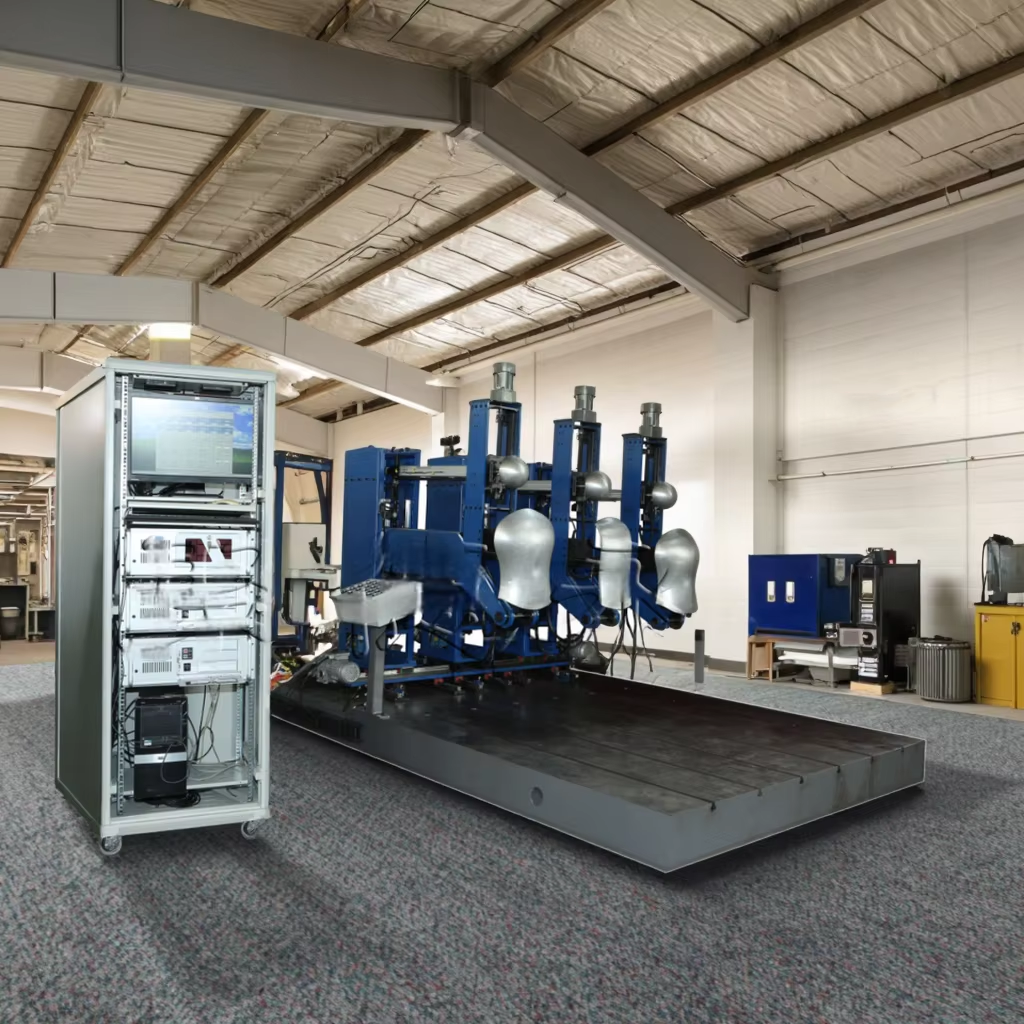
Automotive Seat Three-Station Headrest and Backrest Static Strength Testing Machine,Vehicle seat static load testing rig

Whats/App: +86 156 1874 6768
Web: standard-groups.com
The Automotive Seat Three-Station Headrest and Backrest Static Strength Testing Machine is designed to evaluate the static strength of vehicle seat headrests and backrests. You can use this system to perform assessments on new seat designs, process modifications, material changes, supplier validation, and quality control inspections. It allows for precise, repeatable measurement of load and displacement under controlled conditions, ensuring compliance with automotive safety standards.
Application
This testing machine is suitable for a variety of scenarios in automotive seat design and validation:
Headrest Static Strength Testing: Assess headrest durability and safety under static load.
Backrest Static Strength Testing: Evaluate seatback structural integrity under static load.
Design Verification: Validate new seat designs or material modifications.
Supplier Assessment: Perform qualification and batch inspections of seat components.
Quality Control: Monitor production consistency and ensure compliance with automotive standards.
Typical products tested include automotive seats, headrests, and seatbacks from passenger vehicles, commercial vehicles, and railway seats.
Standards
The machine supports compliance with major international and national standards:
GBI 5083-2019 – Automotive seats, seat anchorage, and headrest strength requirements and test methods.
ECE R17 – Automotive seat and headrest strength test methods and safety requirements.
Parameters
| Parameter Category | Details | Specifications |
|---|---|---|
| Machine Dimensions | Main Test Frame | 3500 × 2000 × 2200 mm |
| Control Cabinet | 600 × 600 × 1800 mm | |
| Power Distribution Cabinet | 800 × 600 × 1000 mm | |
| Power Supply | - | Single-phase AC 220 V, 50 Hz, 5 kW |
| Servo Electric Cylinders | Quantity & Purpose | 9 cylinders total, 6 for headrest/backrest static strength |
| Stroke & Accuracy | 600 mm, ±1% displacement, resolution 0.01 mm | |
| Maximum Thrust & Accuracy | 2 kN, ±1%, resolution 0.1 N | |
| Loading Position | 290 ± 0.25 mm above H-point | |
| Load Sensors | Capacity & Quantity | 2 kN, 6 sensors |
| Accuracy | ±1% | |
| Rated Output | 3 mV/V ± 0.025% | |
| Nonlinearity | 0.5% | |
| Non-repeatability | 0.2% | |
| Optical Encoder Displacement Sensors | Quantity | 9 pcs |
| Linearity | 0.05% F.S. | |
| Repeatability | 0.1% | |
| Other Parameters | Sampling Frequency | 2 kHz |
| Measurement Accuracy | Better than ±1% | |
| Control Accuracy | Better than ±1% |
Features
Full-range load capability without gear segmentation; adjustable loading speed.
High-performance servo electric cylinders with real-time automatic gain adjustment; adaptive filters enable testing from low to high stiffness automatically.
Measurement and control system uses NI high-performance motion control cards; modular and standardized architecture ensures flexibility, interchangeability, and easy maintenance.
Test data stored in a secure database with high confidentiality.
Software allows manual selection of curve points, slope calculation between points, curve scaling and shifting, and export of all sampled points to Excel; multiple curves can be overlaid for batch comparison and custom Excel report generation.
Simple calibration of load and displacement for user-friendly operation.
Modular design of the measurement and control system for easy maintenance.
Safety features include limit protection, overload protection, and software-set protection.
Accessories
Control and motion software suite (pre-installed).
Load cell calibration kit.
Optical encoder calibration fixtures.
Safety shields and limit switches.
Installation and operation manual.
Test Procedures
Ensure the sample is properly mounted and secured on the test frame.
Configure test parameters, including stroke, load, and displacement limits, using the software.
Start the test and monitor load and displacement curves in real-time on the control interface.
Record the results; curves and data can be exported for analysis.
Repeat for multiple samples if required.
Maintenance Information
Inspect servo cylinders, load sensors, and optical encoders regularly for wear or damage.
Calibrate load cells and displacement sensors periodically.
Keep the control cabinet and electronics free of dust and moisture.
Ensure all moving parts are lubricated according to the maintenance schedule.
Verify safety limit switches and overload protection functionality.
Send product request
Other supplier products
 |
FTIR Fourier Transform Infrared Smoke Toxicity Test System,ANSI/CAN/UL 9540A Fourier Infrared Smoke Toxicity Analysis System | Whats/App: +86 156 1874 6768 Web: standard-groups.com The FTIR Fourier Transform Infrared Smoke Toxicity Test System is an integrated gas analysi... |
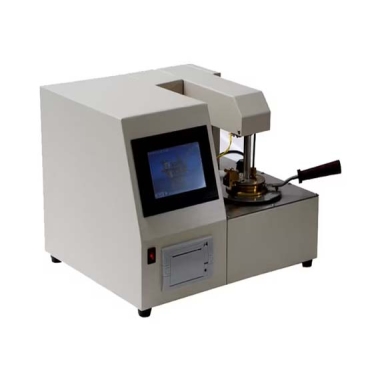 |
Mini Rapid Closed Cup Flash Point Analyzer | Whats/App: +86 156 1874 6768 Web: standard-groups.com Reference Standards: SN/T 3077.1、SN/T 3077.2. SH/T 0768. DL/T 1354. ASTM D93、ASTM D6450... |
 |
Color Spectrum Analyzer | Whats/App: +86 156 1874 6768 Web: standard-groups.com Standard CIE No.15. ISO 7724-1: Meets international colorimetry and spectral measurement s... |
 |
GB/T 19666 Toxicity Index Tester,combustion gas toxicity tester | Whats/App: +86 156 1874 6768 Web: standard-groups.com The GB/T 19666 Toxicity Index Tester is a specialized instrument designed for evaluating th... |
 |
IEC Standard Ozone Aging Chamber Manufacturer China | Get a quote: Whats/App: +86 156 1874 6768 Web: standard-groups.com Applications The Ozone Aging Chamber is used to test the colorfastness and a... |
Same products
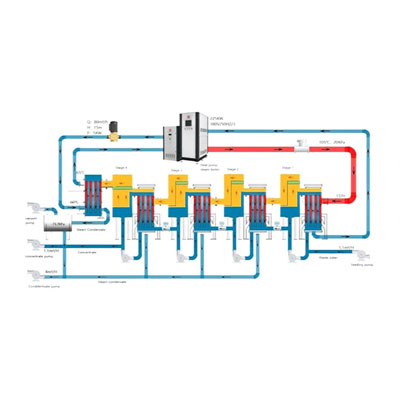 |
PanEVAP & MVR system | Seller: Yangzhou Panstar Heat Exchanger Equipment Co., Ltd | A multiple-effect evaporator is a device that efficiently uses steam heat to evaporate water. Wat... |
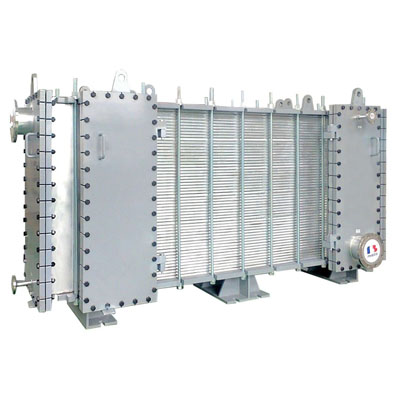 |
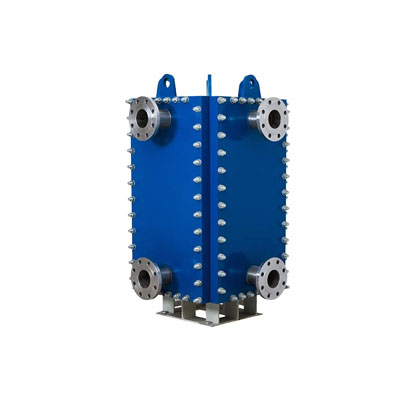
PanGAP wide gap welded plate heat exchanger | Seller: Yangzhou Panstar Heat Exchanger Equipment Co., Ltd | PanGAP wide gap welded plate heat exchangerconsists of a welded plate pack with different channel... |
 |
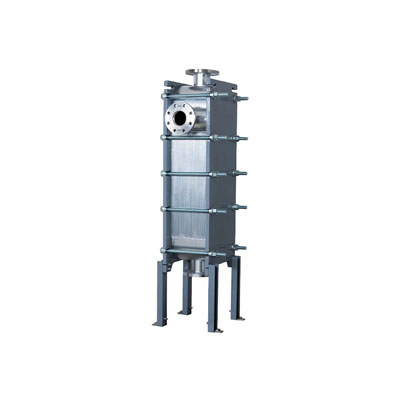
PanBloc welded plate heat exchanger | Seller: Yangzhou Panstar Heat Exchanger Equipment Co., Ltd | PanBloc welded plate heat exchangeris compact and efficient, although fully welded, is totally ac... |
 |
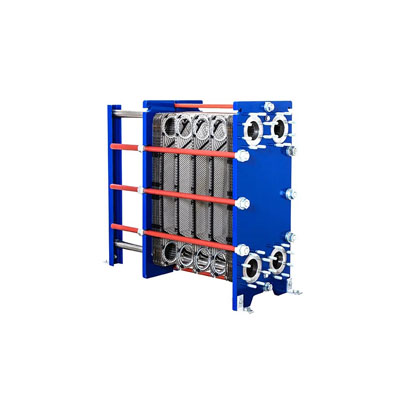
PanBox welded plate heat exchanger | Seller: Yangzhou Panstar Heat Exchanger Equipment Co., Ltd | PanBox welded plate heat exchangerconsists of a laser welded plate pack with optimized corrugated... |
 |
PanPHE gasketed plate heat exchangers | Seller: Yangzhou Panstar Heat Exchanger Equipment Co., Ltd | PanPHE gasketed plate heat exchangersare designed with easy access for regular servicing and for ... |

