

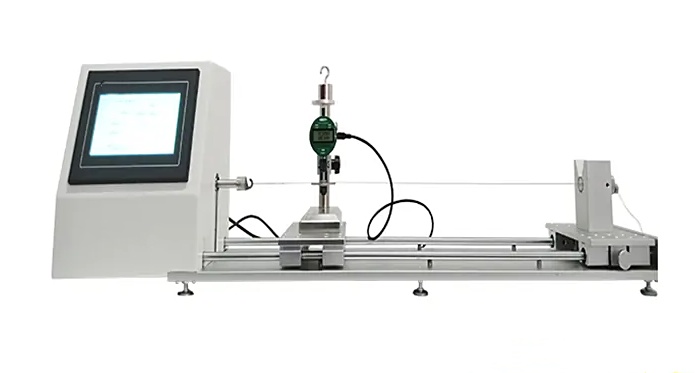
Automated suture line diameter tester

Whats/App: +86 156 1874 6768
Web: standard-groups.com
Standards
The medical suture thread diameter tester needs to comply with relevant medical industry standards, such as YY 1116 - 2020Absorbable Surgical Suture and YY 0167 - 2020 Non - absorbable Surgical Suture. These standards specify in detail the requirements for the technical parameters, testing methods, and measurement accuracy of the suture thread diameter tester, ensuring the accuracy and reliability of measurement results.
Features
1. Compliance
Execution Standards: Designed and manufactured according to the wire diameter testing clauses in YY1116-2020 "Absorbable Surgical Sutures" and YY0167-2020 "Non-absorbable Surgical Sutures".
Allows for measurement at multiple positions, including 1/4. 1/2. and 3/4 of the length; for multi-strand sutures with specifications greater than metric 2. the suture can be rotated 90° for measurement without disassembly.
2. Stability
Uses a grating displacement sensor instead of a micrometer, providing accuracy to one ten-thousandth and excellent stability.
3. Convenience
Manual sample loading, electric tensioning, and multi-point automatic measurement.
To address the issue of changing weights for each specification, it innovatively uses a high-precision force sensor to automatically set the tension force, making operation simple.
Equipped with quick mechanical buttons for testing and stopping, allowing for one-button testing and pausing.
4. Intelligence
A 7-inch color touch screen combined with intelligent data processing functions provides users with a comfortable and smooth operating experience.
Touch screen operation: Nominal specification, test load, printing, testing, left movement, right movement, time, calibration.
Technical Parameters
| Serial No. | Parameter Item | Parameter Details |
|---|---|---|
| 1 | Minimum Division Value | Not exceeding 0.002mm (some high-precision devices can reach 0.001mm), ensuring precise suture thread diameter measurement |
| 2 | Base Diameter | Usually greater than 50mm, providing stable basic support for measurement |
| 3 | Pressing Plate Diameter | 12.70mm±0.02mm, used to apply pressure to the suture thread for diameter measurement |
| 4 | Presser Foot Load | Varies by suture thread specifications:- For specifications > nominal size 0.4 (or 8-0): 210g±3g- For specifications ≤ the above size: ≤60g |
| 5 | Calibration Difference and Parallelism Difference | Not greater than 0.005mm (between pressing plate surface and base), ensuring measurement accuracy |
Accessoriess
One main unit, one certificate of conformity, accompanying fixtures, one instruction manual, and one roll of printing paper.
Test Procedures
1. Preparation Before Operation
Equipment and Environment Check:
Connect the power supply (suitable for wide voltage range), start the equipment and confirm that the operating interface is functioning correctly; place the equipment in a standard testing environment of **22±2℃ and 50±5% humidity**, ensuring the workbench is stable and vibration-free.
Sample Preparation:
Select suture samples that meet the standards of "YY 1116-2020 Absorbable Surgical Sutures" and "YY 0167-2020 Non-absorbable Surgical Sutures," cut them to a length of 10-15cm, ensuring the sutures are clean, untwisted, and undamaged.
Equipment Pre-check:
Confirm the condition of the components, including the press plate diameter (12.70mm±0.02mm) and base diameter (≥50mm), ensuring there is no wear or deformation.
2. Equipment Calibration (Ensuring Measurement Accuracy)
Baseline Calibration:
In the unloaded state, verify the "calibration difference and parallelism difference between the press plate surface and the base," ensuring the error is ≤0.005mm; calibrate the minimum division value (typically ≤0.002mm, high-precision models ≤0.001mm) using the equipment's built-in calibration program.
Press Foot Load Calibration:
Set the press foot load according to the suture specifications:
Suture specifications > nominal 0.4 (or 8-0): Calibration load is 210g±3g;
Specifications ≤ nominal 0.4 (or 8-0): Calibration load ≤60g.
3. Sample Installation
Place the suture naturally in the center of the base, ensuring the suture is not stretched or twisted; adjust the position of the press plate so that it is aligned with the area of the suture to be measured, avoiding contact between the suture and other parts of the equipment.
4. Parameter Settings
Select the corresponding standard (YY 1116-2020/YY 0167-2020) through the operating interface and set:
Measurement mode (single measurement/multi-position average measurement);
Press foot load matching the sample specifications;
Minimum division value (select 0.001mm/0.002mm accuracy as needed). 5. Test Execution
After confirming the parameters are correct, start the test; the device automatically drives the pressure plate to apply the set load to the suture, and simultaneously collects diameter data.
It is recommended to measure 3-5 different positions on a single suture to obtain multiple data sets to improve result stability.
6. Data Processing and Application
The device automatically calculates the average measurement value and displays the individual data sets and the average;
A report is generated containing "sample information, measurement data, calibration records, and compliance with standards," which is used for:
Quality control: verifying whether the suture diameter meets medical standards;
Production testing: real-time monitoring of diameter deviations in batch products;
Third-party inspection: providing high-precision data for compliance verification of products in the market.
7. Post-Test Maintenance
Turn off the device power, and clean any remaining suture fibers from the base and pressure plate surface;
Record the device usage status, and regularly re-examine the pressure plate wear and sensor accuracy to ensure the long-term stable operation of the equipment.
Send product request
Other supplier products
 |
Buy prefilled syringe force tester machine | Whats/App: +86 156 1874 6768 Web: standard-groups.com Standards YY/T 0962 - 2021 : Determination of Push-force for Prefilled Syringes, etc. Fea... |
 |
Ink drying apparatus | Whats/App: +86 156 1874 6768 Web: standard-groups.com How it works: The working principle of the ink drying instrument is based on simulating th... |
 |
High and low temperature memory impact testing machine | Whats/App: +86 156 1874 6768 Web: standard-groups.com The High and Low Temperature Memory Impact Testing Machine is a computer-controlled pendulu... |
 |
Universal Wear Tester丨Universal Wear Test Machine | Whats/App: +86 156 1874 6768 Web: standard-groups.com The Universal Wear Tester is used to test wear and abrasion resistance of fabrics for appar... |
 |
Contact Lens Spectral Transmittance Analyzer | Whats/App: +86 156 1874 6768 Web: standard-groups.com Product Introduction: Contact lens spectral transmittance measuring instrument is a kind o... |
Same products
 |
ER4047 Aluminum Mig Welding Wire | Seller: 868776 | Hangzhou Kunli Welding Materials Co., Ltd. specializes in manufacturing reliable welding material... |
 |
ER4043 Silicon Aluminum Welding Wire | Seller: 868776 | Hangzhou Kunli Welding Materials Co., Ltd. specializes in manufacturing high-quality welding mate... |
 |
Choosing the Right Equipment for Heavy-Duty Cleaning | Seller: Taizhou Feike Mechanical Technology Co., Ltd. | FEIKE’s High Pressure Washer is designed for industrial cleaning, equipment maintenance, ve... |
 |
ER4043 Silicon Aluminum Welding Wire | Seller: 868776 | Hangzhou Kunli Welding Materials Co., Ltd. offers ER4043 Silicon Aluminum Welding Wire for alumin... |
 |
HDPE High Speed Water Cooled Double Wall Corrugated Pipe Extrusion Line | Seller: Shandong HUASU Plastic Technology Co.,Ltd. | The molds adopt the double flow channel structure and nitriding polishing processed die head. Thi... |

