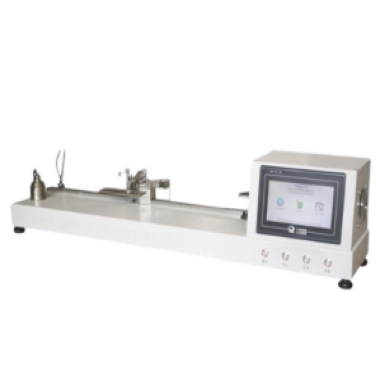
Yarn Twist Tester

Application Scope
The yarn twist tester is an instrument used to measure the twist of yarns and their related technical indicators.
Applicable Standards
1. GB/T 2543.1: Textiles - Determination of yarn twist - Part 1: Direct counting method.
2. GB/T 2543.2: Textiles - Determination of yarn twist - Part 2: Untwist - retwist method.
3. ISO 2061: Textiles - Determination of yarn twist - Direct counting method.
4. ISO/DIS 17202: Textiles - Determination of yarn twist (Note: This standard may be updated over time. Please confirm the latest version before use).
5. BS 2085: Relevant clauses regarding yarn twist measurement in British standards.
6. ASTM D 1422 and ASTM D 1423: Standards regarding yarn twist measurement issued by the American Society for Testing and Materials (ASTM).
Main Parameters
1. Test range: Applicable to the twist test of various yarns and ply yarns such as cotton, wool, silk, chemical fibers, etc.
2. Twist range: Usually, it can measure a relatively large twist range, such as 1 - 99999.99 twists, to meet the test requirements of different yarns.
3. Yarn tension: There is a set of weights for adjusting yarn tension. The weight configuration may include multiple 0.5 cN, 1 cN, 2 cN, 5 cN, 10 cN, 20 cN, etc. The specific configuration may vary depending on the equipment. The magnitude of the tension can be adjusted according to the type of yarn.
4. Rotational speed: The rotational speed of the chuck or rotating holder can usually be continuously adjusted within a certain range, such as 100 r/min - 2000 r/min or 100 r/min - 1900 r/min, etc., to meet the needs of different test speeds and yarn characteristics.
5. Test length: The test length can usually be set arbitrarily within a certain range, such as 10 - 500 mm, etc., to meet the requirements of different test standards and yarn lengths.
6. Test methods: It may include multiple test methods such as direct counting method, single untwist - retwist method, double untwist - retwist method, triple untwist - retwist method, etc., to meet the requirements of different yarns and test standards.
7. Data output method: Usually has display output and print output functions. The display output can show parameters such as the number of tests, single twist value, twist factor, etc. through a touch screen or LCD display; the print output can realize Chinese or English printed reports by connecting a printer.
8. Power supply: Usually powered by AC220V 50HZ, but the specific voltage and frequency may vary depending on the equipment.
Другие товары поставщика
|
|
Thermal Protective Performance Tester (TPP)-QINSUN |
The Thermal Protective Performance (TPP) Test Device was developed to measure the time elapsed for convective and radiant heat to penetrate through... |
|
|
Qinsun UV-master |
In response to the climate resistance testing requirements for outdoor textiles, this equipment can simulate outdoor climate conditions and accel... |
|
|
Color fastness tester for ironing sublimation |
Color fastness tester for ironing sublimation - Testing instrument for ironing color fastness of materials
G247B Color fastness tester for ironing... |
|
|
Automatic dry cleaning tester |
Instrument Purpose
The YG-6 Fully Automatic Dry Cleaning Tester is used to evaluate the physical properties of wool, fur, cotton-linen, worsted, a... |
|
|
Manual Vision Measuring Machine |
Product Introduction:
The manual imager can efficiently detect the outline and surface shape of a variety of complex workpieces, such as: template... |
Все товары поставщика
Похожие товары