foundry equipment manufacturers



Introduction The lost foam process molding equipment originated in 1958 when H.F. Shroyer was granted a patent for a cavity-less casting method, using a polystyrene foam pattern embedded in traditional green sand. The polystyrene foam pattern left in the sand is decomposed by the poured molten metal. The metal replaces the foam pattern, exactly duplicating all of the features of the original pattern. Like other investment casting methods, this requires that a pattern be produced for every casting poured because it is evaporated ("lost") in the process. Process Steps 1.Mold foam pattern sections. 2.Age pattern to allow dimensional shrinkage. 3.Assemble pattern if it is a multiple piece pattern. 4.Build cluster (multiple patterns per cluster). 5.Coat cluster. 6.Dry coating. 7.Compact cluster in flask. 8.Pour metal. 9.Extract cluster from flask. Black area------sand preparation and molding system 1. manipulator 2. winnowing Magnetic separators 3. sanded-up equipment 4. vibrating conveying screen classifier 5. chain elevator 6. water-cooled sand cooling equipment 7. tri-dimensional vibrating table 8. vacuum system 9. dust collector White area------make the foam mould 1. batch-type pre-foaming machine 2. vertical type mould forming machine 3. bonder machine 4. coating stirring mill 5. hot gas far infra red drying oven Advantage and disadvantage This casting process is advantageous for very complex castings that would regularly require cores. It is also dimensionally accurate, maintains an excellent surface finish, requires no draft, and has no parting lines so no flash is formed. The un-bonded sand of lost foam casting can be much simpler to maintain than green sand and resin bonded sand systems. Lost foam is generally more economical than investment casting because it involves fewer steps. Risers are not usually required due to the nature of the process; because the molten metal vaporizes the foam the first metal into the mold cools more quickly than the rest, which results in natural directional solidification. Foam is easy to manipulate, carve and glue, due to its unique properties. The flexibility of LFC often allows for consolidating the parts into one integral component; other forming processes would require the production of one or more parts to be assembled. The two main disadvantages are that pattern costs can be high for low volume applications and the patterns are easily damaged or distorted due to their low strength. If a die is used to create the patterns there is a large initial cost.
Отправить запрос, связаться с поставщиком
Другие товары поставщика
 |
The history Vacuum seal modeling technology (also called V method modeling) is the 1970s Japan invented and the successful development of a specia... | |
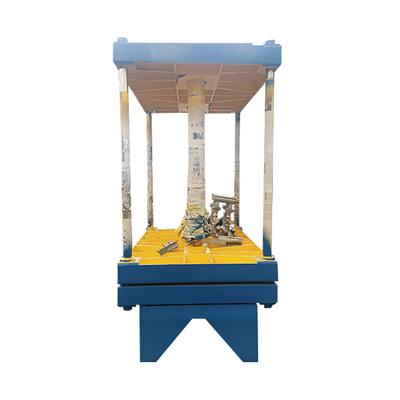 |
Lost Foam Screw Molding Equipment&hydraulic Molding Machine,Website: Foam Molding Machine | |
|
|
Vibrating Sand Conveyor Machine&screening Machine | Vibrating Sand Conveyor Machine&screening Machine,Lost Foam Molding Machine |
|
|
Lost foam process molding equipment for automobile parts | Introduction The lost foam process molding equipment originated in 1958 when H.F. Shroyer was granted a patent for a cavity-less casting method, u... |
|
|
The Lost Foam Casting Process | The Lost Foam Casting Process This process eliminates the need for sand binders and cores. The sand is unbonded and a foam pattern is used to fo... |