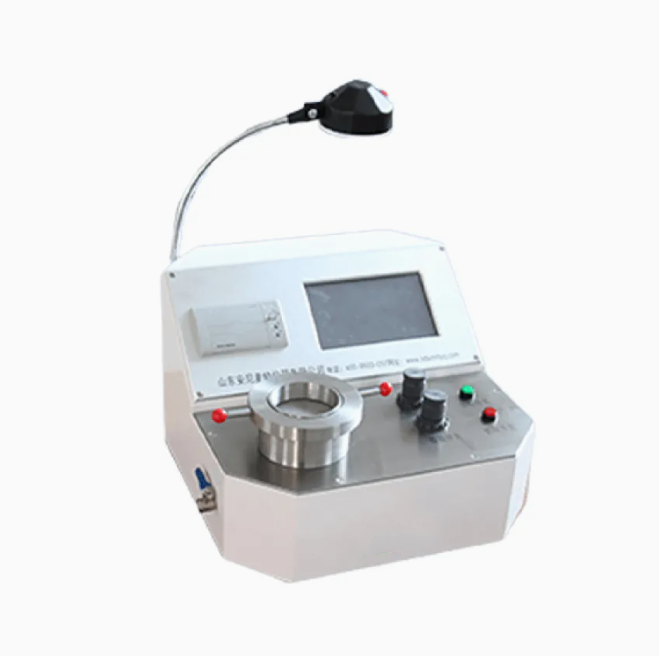
Filter Membrane Pore Analysis Tester,ASTM F316 Compliant Pore Structure Tester

Whats/App: +86 156 1874 6768
Web: standard-groups.com
The Filter Membrane Pore Analysis Tester is a precision instrument designed to measure the pore size, distribution, and integrity of flat filter membranes. Utilizing the principle of capillary flow porometry, the tester provides quantitative data on bubble point, mean flow pore size, and full pore size distribution. This information is critical for evaluating filtration efficiency, flow rate, and retention performance of membranes used in microfiltration, ultrafiltration, and sterile filtration applications.
Application
(1) Determining pore size distribution, bubble point, and mean flow pore size of flat filter membranes.
(2) Quality control in the production of filtration membranes to ensure consistency and compliance with specifications.
(3) Research and development of new membrane materials and designs.
(4) Characterization of membranes for various filtration applications, including water purification, pharmaceutical, food & beverage, and chemical processes.
(5) Investigating performance issues in membranes, such as defects, irregular pore sizes, or compromised integrity.
(6) Validation of membrane integrity and performance for sterilization and critical filtration processes.
Standards
(1) ASTM E1294 — Standard Test Method for Pore Size Characteristics of Membranes by Bubble Point and Mean Flow Pore Test
(2) ASTM F316 — Standard Test Method for Pore Size Characteristics of Membrane Filters by Capillary Flow Porometry
(3) ISO 4003 — Determination of Pore Size and Bubble Point of Membranes
(4) ISO 15901-2 — Pore size distribution and porosity analysis of materials using capillary flow methods
(5) USP — Particulate Matter in Injections (relevance for sterile filtration membrane validation)
(6) EN 14683 — Medical face masks: bacterial filtration performance (membrane evaluation)
Features
(1) Provides precise, quantitative measurements of pore size, bubble point, and mean flow pore size.
(2) Generates full pore size distribution for comprehensive characterization of membranes.
(3) Standard-compliant testing for ASTM, ISO, and other internationally recognized protocols.
(4) Non-destructive testing for certain conditions, allowing membranes to remain intact after measurement.
(5) Automated control system for wetting, pressurization, flow measurement, and data acquisition.
(6) Digital display and software for real-time monitoring and detailed analysis.
(7) Compatible with a wide range of membrane types, materials, and pore size ranges.
(8) Safety features for handling pressurized systems and fluids.
Technical Parameters
| Parameter | Specification |
|---|---|
| Pressure Range | 0–500 kPa (adjustable) |
| Pressure Resolution | 0.01 kPa |
| Gas Flow Range | 0–5000 mL/min |
| Flow Accuracy | ±1% FS |
| Bubble Point Measurement | Automatic detection of first gas flow through largest pore |
| Mean Flow Pore Size | Calculated from flow vs. pressure curve |
| Sample Size | Flat membrane: 10–100 mm diameter (custom holders available) |
| Temperature Monitoring | 0–50°C with ±0.5°C accuracy |
| Wetted Fluids | Water, alcohol, or other standard wetting liquids |
| Control System | PLC or microcontroller-based automatic operation |
| Data Output | PC software, USB, or Ethernet |
| Display | Real-time pressure, flow, and test status |
| Power Supply | AC 220V 50Hz |
Accessories
(1) Membrane holders/cells for various sample sizes
(2) Wetting fluid reservoir and tubing
(3) Pressure transducers and gas flow meters
(4) Automated control software for testing sequences
(5) Digital display or PC interface
(6) Calibration kit for pressure and flow verification
(7) Safety valves and emergency stop system
Test Procedures
Secure the flat membrane specimen in the holder, ensuring a tight seal between upstream and downstream sides.
Saturate the membrane pores with a wetting fluid.
Gradually apply non-wetting gas to the upstream side, monitoring pressure and flow.
Identify the bubble point pressure where the first gas flow occurs, indicating the largest pore size.
Continue pressurization to measure the flow rate vs. pressure relationship for calculating mean flow pore size and pore size distribution.
Record and analyze data using the instrument software to generate bubble point, mean flow pore size, and pore size distribution curves.
Repeat measurements for multiple samples to ensure reliability.
Maintenance Information
(1) Regularly clean membrane holders and fluid reservoirs to prevent contamination.
(2) Inspect gas flow lines and pressure transducers for leaks or blockages.
(3) Calibrate pressure and flow sensors periodically for measurement accuracy.
(4) Replace wetting fluids and clean thoroughly to maintain consistent test conditions.
(5) Ensure safety valves and emergency stop systems are functional before operation.
(6) Store the instrument in a clean, dry environment to prevent corrosion or damage to sensitive components.
Send product request
Other supplier products
 |
Flammability test furnace for building materials,Flammability testing chamber for building materials | Whats/App: +86 156 1874 6768 Web: standard-groups.com Product Introduction: Touch screen control building materials flammability test furnace ad... |
 |
Automotive Seat Headrest Testing System | Insertion and Pull-Out Force Test Equipment | Get a quote: Whats/App: +86 156 1874 6768 Web: standard-groups.com Features Accurately measures insertion and withdrawal forces of seat headres... |
 |
Aircraft Component Combustion Testing System,aircraft flame retardant system | Whats/App: +86 156 1874 6768 Web: standard-groups.com Product description: With the increasing maturity of aviation technology, the flame retard... |
 |
Safety Helmets Against Molten Metal Splashing Tester | Whats/App: +86 156 1874 6768 Web: standard-groups.com Standard GB/T 2812-XXXX: Safety Helmets – Test Methods for Molten Metal Resistance (... |
 |
Adhesion Tester for quality control | Whats/App: +86 156 1874 6768 Web: standard-groups.com Standards - Specific standards for different test objects, such as the adhesion test stand... |