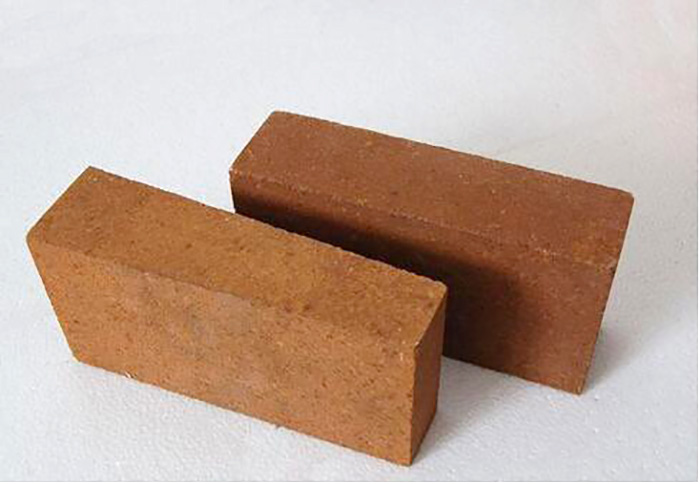
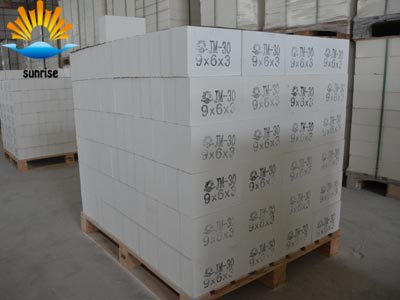
Lightweight high-alumina bricks are important heat-insulating materials for thermal furnaces

The rational manufacture and selection of lightweight high-alumina bricks are of great significance to the rational use of energy and the correct implementation of China's energy policies. Among various lightweight insulation materials, lightweight high-alumina bricks have high refractoriness and small bulk density; raw materials are abundant, and refractory bricks are inexpensive, which is an ideal heat insulation material. According to the manufacturing process, lightweight high-alumina bricks can be made by foaming or adding a person.
1. Production process of lightweight high-alumina bricks by foaming
The use of A12O3 content of about 55% of the heavy grade high alumina bauxite powder and A12O3 content of 31-32% of the combined clay fine as raw materials. The ratio of high-alumina bauxite clinker and bound tretaceous fine powder is 9:1. Add 48-50% of the water and grind it in the ball mill for 1-2h. The slurry will all pass through the 0.2mm sieve, the mud weight will be 1.7-1.9, and the pH value will be 7. The foaming agent was prepared using sodium rosinate. The sodium rosinate foaming agent is made of rosin and alkali saponification, and is formulated with a stabilizer bone glue solution.
First, 322 g of caustic soda was dissolved in 2 L of water to prepare a caustic soda aqueous solution having a concentration of 14.4% and a specific gravity of 1.16. In the boiling caustic soda solution, add rosin with a particle size of less than 5 mm in a ratio of 1:1 and boil for about 1-2 h. The bone glue should adopt white animal bone glue or transparent bone glue. The ratio of bone glue to water is 1:1, the temperature of the tannin glue is 5°C, and the tannin glue time is 5-10 minutes. The bone glue heated to 40°C was slowly poured into the rosin soap and placed in a bubbler for bubbling. The bubbling time was 5-10 minutes. The slurry is prepared in a blender. Slurry. Aluminium potassium sulphate solution, sulphite pulp waste liquid according to the design ratio down stirring in the mixer l ~ 2min; adding the foaming agent, stirring for 5-10min. By controlling the difference in the specific gravity of mud, various lightweight high-alumina bricks with a bulk density ranging from 0.4 to 0.8 can be obtained.
The casting of lightweight high alumina bricks was performed on iron plates placed under a porous aluminum mold. The inner wall of the model has 5-6 layers of paper. The molding slurry was slowly poured into the mold until it was full. Also slightly vibrate to make the body uniform and reduce cracking. The green body can be demoulded after drying at 35-45°C for 24h; after 7d, the water content of the green body is less than 1%. Into the kiln at 1300-1340 °C firing. The physical and chemical indexes of the foam lightweight high alumina bricks with the grade of 0.4 are as follows: bulk density 0.4g/cm3, compressive strength 0.7-1. 5MPa, reburning shrinkage-0.1%, refractoriness 1770°C, Al2O352%, Fe2O3 3.3%. The production of lightweight high-alumina bricks with different bulk densities depends mainly on the proportion of mud. At the same time, it is also affected by the foam stabilizer and sintering temperature. The better the foam stability, the smaller the specific gravity of the refractory bricks; the higher the firing temperature, the greater the shrinkage of the refractory bricks and the greater the bulk density. Therefore, according to the different raw materials used, accurately determining the firing temperature, the preparation of a good stability of the mud is the key to the production of high quality light high alumina brick.
2. Combustible addition method
The addition of flammable substances to the mud can also produce lightweight firebricks with a bulk density of 0.8. The combustible characters used in production include sawdust, rice husk, coke powder, and anthracite. The requirements for combustible additions are easy to burn, low ash, and low levels of harmful impurities in the ash. Sawdust and rice husks are generally used, and the added amount is generally 30-40%. Sawdust needs to be sieved; rice husks can be milled together with high alumina bauxite. The clinker and flammable characters are mixed in a wet mill for 4-5 minutes, or squeezed into mud by a screw extruder. Peat moisture 40-50%.
The mixed mud can be molded in a wooden model. The wooden model was first wetted with water, brushed with sawdust, and then loaded into the mud, and then the mold was removed after being scraped. After the green body is dried, it is fired at the desired temperature.
Other supplier products
All supplier products
Same products
|
|
Microcrystalline wax used for packaging and paper processing |
Seller: Syntop chemical Co.,Ltd. |
Microcrystalline wax has a wide range of industrial applications. Its core value lies in th... |
|
|
Microcrystalline wax used for rubber and tires |
Seller: Syntop chemical Co.,Ltd. |
In industrial applications, microcrystalline wax is primarily used for rubber protection, thicken... |
|
|
Microcrystalline wax used for shoe polish processing |
Seller: Syntop chemical Co.,Ltd. |
Microcrystalline wax is commonly used in shoe polish, primarily to harden the formula, adju... |
|
|
Microcrystalline wax used for rubber plastic processing and modification |
Seller: Syntop chemical Co.,Ltd. |
Microcrystalline wax has a wide range of industrial applications, primarily in the areas of rubbe... |
|
|
Microcrystalline wax 80A used for lubrication and demolding |
Seller: Syntop chemical Co.,Ltd. |
The core industrial applications of microcrystalline wax 80A are primarily focused on rubber prot... |