

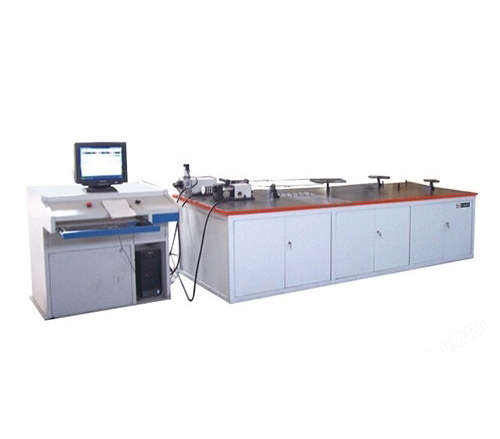
Automotive & Motorcycle Control Cable (Flexible Shaft) Efficiency Tester,Motorcycle and car cable efficiency testing rig

Whats/App: +86 156 1874 6768
Web: standard-groups.com
The Automotive & Motorcycle Control Cable (Flexible Shaft) Efficiency Tester is designed to measure the load and displacement efficiency of automotive and motorcycle control cable assemblies under specified working conditions. By applying controlled push-pull forces to both ends of the cable and synchronously collecting force and displacement data, it quantitatively evaluates the transmission efficiency for various routing configurations and working strokes, providing reliable data for design verification, type testing, and quality inspection.
Application
This tester is applicable for efficiency testing of various vehicle control cables and flexible shafts, including:
(1) Automotive throttle cable efficiency testing
(2) Automotive clutch cable efficiency testing
(3) Automotive gear shift cable efficiency testing
(4) Automotive brake and parking brake cable efficiency testing
(5) Motorcycle throttle, clutch, and brake cable efficiency testing
(6) Bowden cables and flexible shaft transmission efficiency testing
(7) Control cables for electric vehicles, light vehicles, and specialty vehicles
(8) R&D, type testing, and mass production quality inspection of control cables
Standards
(1) Q/CT 29101-92 — Automotive Cable Assemblies
(2) QC/T 29101-2014 (Reference) — Automotive Control Cable Assemblies
(3) Q/SQR.04.828-2007 — Automotive Control Cable Efficiency Test Method
(4) Q/SQR.04.285 — Automotive Control Cable Performance Test Specification
(5) Q/SQR.04.405-2006 — Motorcycle Control Cable Assemblies Test Method
(6) Q/SQR.04.821-2007 — Automotive & Motorcycle Flexible Shaft and Cable Performance Test Specification
Parameters
| Item | Technical Specification |
|---|---|
| Maximum Pull Force (Tension End) | 5000 N |
| Maximum Push/Pull Force (Fixed End) | 5000 N |
| Maximum Stroke | 100 mm |
| Push/Pull Speed | 1–100 mm/min, steplessly adjustable |
| Displacement Sensor Accuracy | ±1% |
| Displacement Display Accuracy | ±1% |
| Load Measurement | Force sensors |
| Displacement Measurement | High-precision displacement sensors |
| Display | Real-time force, displacement, and efficiency |
| Curve Display | Force–Force, Displacement–Time curves |
| Print Function | Test data and curves output |
Features
(1) Dual-end synchronous measurement — Measures force and displacement at both tension and fixed ends for accurate efficiency calculation.
(2) Multiple routing simulation — Curve forming mechanism supports S-shape, U-shape, and other cable layouts to mimic real vehicle installations.
(3) Real-time efficiency display — Shows load and displacement efficiency and variation, enabling quick assessment of cable performance.
(4) Adaptive clamping structure — T-shaped sliding guide accommodates cables of different lengths and structural types.
(5) Stable low-speed loading — Stepless adjustable push/pull speed to meet standards’ loading rate requirements.
(6) Traceable data — Supports curve display and printing for quality records, analysis, and archiving.
Accessories
| Name | Description |
|---|---|
| Cable-specific fixtures | Secure cable ends |
| T-shaped guide plate | Cable installation and routing |
| Curve forming mechanism | S-shape or U-shape routing simulation |
| Force sensors | Measure tension and fixed end load |
| Displacement sensors | Measure stroke and displacement |
| Print paper | Output for test data and curves |
| Fasteners | For fixing specimens |
Test Procedures
(1) Install the cable specimen according to the selected layout (straight, S-shape, or U-shape) per the applicable standard.
(2) Securely clamp both ends using the appropriate fixtures to prevent slippage.
(3) Set push/pull speed according to the relevant standard or company specification.
(4) Start the test; the system applies controlled push-pull forces while measuring force and displacement at both ends.
(5) Monitor the test to ensure smooth loading and consistent data collection.
(6) Upon completion of the specified stroke or cycle, stop the test.
(7) Record data, generate force–force and displacement–time curves, and calculate load and displacement efficiency.
Maintenance Information
(1) Regularly check the clamping fixtures, T-guides, and curve forming mechanisms for wear or loosening.
(2) Keep moving parts clean and lubricated.
(3) Periodically verify the calibration and accuracy of force and displacement sensors.
(4) Replace consumables such as print paper as needed.
(5) Ensure the control system and power supply are functioning properly.
在线联系供应商
Other supplier products
 |
Office Chair Caster Durability meter | Whats/App: +86 156 1874 6768 Web: standard-groups.com Implementation standards GB/T4085 EN425 Product features 1. The instrument adopts PLC to... |
 |
Shoe Abrasion Tester | Whats/App: +86 156 1874 6768 Web: standard-groups.com TheShoe Abrasion Testeris designed to evaluate the wear resistance of shoe soles and sole p... |
 |
Leather edge oil fatigue testing machine | Whats/App: +86 156 1874 6768 Web: standard-groups.com The Leather Edge Oil Fatigue Testing Machine is designed to evaluate the fatigue resistance... |
 |
Mechanical Scratch Tester | Whats/App: +86 156 1874 6768 Web: standard-groups.com Application Primary test purposes Coating scratch resistance evaluation Coating hardness... |
 |
Catheter Balloon Inflation Diameter Tester | Whats/App: +86 156 1874 6768 Web: standard-groups.com Applications The catheter cuff inflated diameter tester is mainly used to measure the diam... |
Same products
 |
ER4043 Silicon Aluminum Welding Wire | 卖方: 868776 | Hangzhou Kunli Welding Materials Co., Ltd. offers ER4043 Silicon Aluminum Welding Wire for alumin... |
 |
HDPE高速水冷双壁波纹管生产线 | 卖方: Shandong HUASU Plastic Technology Co.,Ltd. | 机头模具采用双流道结构、氮化磨光处理机头,偏壁调整方便快捷,保证内外层壁厚均匀和稳定成型。 最新设计密闭压力水冷冷却结构,冷却充分,多点分布真空系统,效率更高,生产速度更快。 双层在线扩口功... |
 |
PanEVAP & MVR system | 卖方: Yangzhou Panstar Heat Exchanger Equipment Co., Ltd | A multiple-effect evaporator is a device that efficiently uses steam heat to evaporate water. Wat... |
 |
PanGAP wide gap welded plate heat exchanger | 卖方: Yangzhou Panstar Heat Exchanger Equipment Co., Ltd | PanGAP wide gap welded plate heat exchangerconsists of a welded plate pack with different channel... |
 |
PanBloc welded plate heat exchanger | 卖方: Yangzhou Panstar Heat Exchanger Equipment Co., Ltd | PanBloc welded plate heat exchangeris compact and efficient, although fully welded, is totally ac... |

