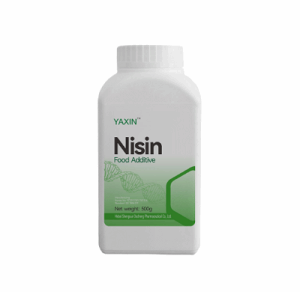
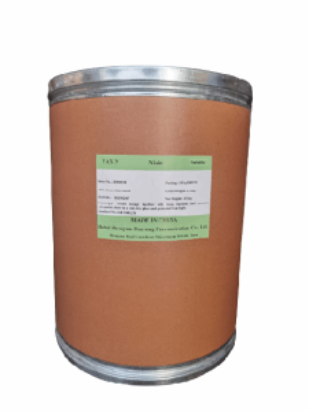
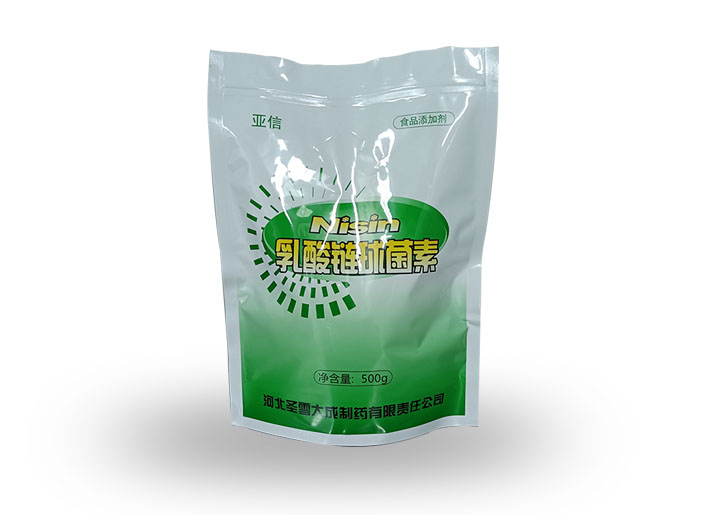
Nisin 1kg

Nisin is a natural antimicrobial peptide produced by certain strains of lactic acid bacteria, particularly Lactococcus lactis. It is widely used as a food preservative due to its ability to inhibit the growth of various bacteria, including some foodborne pathogens. Here are some physical and chemical properties of Nisin:
1. Physical Properties:
Appearance: Nisin is a white to slightly yellowish powder.
Solubility: It is soluble in water.
Odor: Generally odorless.
Molecular Weight: The molecular weight of Nisin is approximately 3350 Da.
2. Chemical Properties:
Chemical Structure: Nisin is a polycyclic peptide with 34 amino acid residues, including unusual amino acids such as lanthionine and methyllanthionine. It is classified as a lantibiotic due to the presence of these thioether linkages.
Stability: Nisin is stable under normal storage conditions and is relatively resistant to heat, acids, and proteolytic enzymes. However, it can be inactivated by certain proteolytic enzymes and some metal ions.
pH Sensitivity: The activity of nisin is pH-dependent, and it is more effective in acidic conditions.
Temperature Sensitivity: While relatively stable at elevated temperatures, prolonged exposure to high temperatures can result in the loss of its antimicrobial activity.
Metal Sensitivity: Nisin can be affected by the presence of certain metal ions, and its activity may be reduced in the presence of divalent cations such as calcium and magnesium.
3. Antimicrobial Activity:
Target Microorganisms: Nisin primarily targets Gram-positive bacteria, including important foodborne pathogens such as Listeria monocytogenes and Staphylococcus aureus.
Mode of Action: Nisin disrupts bacterial cell membranes by forming pores, leading to leakage of cellular contents and eventual cell death.
4. Applications:
Food Preservation: Nisin is commonly used as a natural preservative in various food products, including dairy, meat, and canned goods.
Pharmaceuticals: It has potential applications in the pharmaceutical industry for its antimicrobial properties.
Biotechnology: Nisin is also employed in biotechnological processes.
Regulations regarding the use of Nisin may vary in different countries, and acceptable usage levels should be adhered to for food safety.
Другие товары поставщика
|
|
Nisin Raw Material 1kg |
Nisin is generally safe for long-term use, with minimal side effects: Common side effects: Mild GI discomfort (e.g., bloating, gas) in <5% of us... |
|
|
Nisin Raw Material |
Nisin is widely approved for use in food globally, with strict safety standards:
GRAS designation: The FDA (U.S.) and EFSA (EU) have classified n... |
|
|
Nisin |
Fundamental Properties of NisinSource: Biosynthesized by Lactococcus lactis during fermentation (e.g., in the production of cheese or fermented mil... |
|
|
Nisin in the Prepared Meal Industry |
Standardized Application of Nisin in the Prepared Meal Industry 1. Scope of Application In accordance with GB 2760—2017 National Food Safety ... |
|
|
Nisin Supplier |
New products coming soon!Welcome to inquire and book! 1. Animal Feed Industry Natamycin is added to animal feed to prevent mold contamination durin... |
Все товары поставщика
Похожие товары