Heterophilic Blocking Reagent

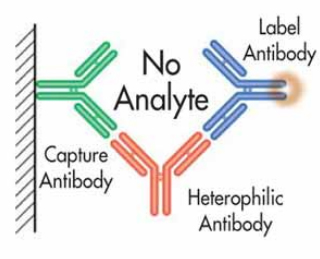
Heterophilic antibodies refer to antibodies that have two or more different antibody structures. Usually, heterophilic antibodies are produced by two or more different clones of B cells, and the antibodies they synthesize contain two or more different heavy or light chains. These different chains can be produced by homologous or heterologous recombination, making heterophilic antibodies have multiple subtypes and specificities.
Heterophilic antibodies in human serum (Heterophilic antibodies) have been shown to cause false positive or false negative interference in immunological assays. Adding HBR to the immunological assay can eliminate the interference of heterophilic antibodies.
Heterophilic Blocking ReagentIntended Use
HBR is a liquid reagent that can be added to the immunological assay to eliminate heterophilic interference (false positive and false negative) in certain human samples.
SEKBIOHeterophilic Blocking Reagent(HBR Product) Detail
Heterophilic antibodies can impact a variety of assays, but they have the most significant effect on sandwich immunoassays.
The traditional passive blocking method involves using non-specific substances (such as mouse IgG, mouse serum, non-specific monoclonal antibodies, polymeric IgG, etc.) to block the binding of human heterophilic antibodies. The blocking effect of all methods depends on the avidity of human heterophilic antibodies.
Our HBR products achieves blocking in a completely different way.HBR can actively bind to human heterophilic antibodies, resulting in a steric hindrance effect and preventing interference. Our HBR products offers the following advantages over traditional blockers:
Saveyour cost!Only a small amount of HBR is required for blocking without reducing the detection signal.
Our HBR can block all subtypes of anti-mouse monoclonal antibodies (such as anti-mouse IgG1, anti-mouse IgG2, etc.).
Our HBRcan be applicable for all immunoassayand is not limited to certain assays.
Storage temperature:
Store at -20°C or below.
Instructions for use:
Thaw the blocking reagent and add it to the reagent components, mix well.
This evaluation experiment utilized a fluorescent lateral flow assay and tested six clinical samples. The results demonstrated that SEKBIO's blocker outperformed Top brand’s blocker.
Heterophilic Blocking Reagent Principle
Heterophilic samples refer to serum or plasma samples with specific antibodies that can bind to the animal antibodies used in immunoassays. The interference caused by heterophilic antibodies is commonly reported as false positives, but false negatives have also been reported. Common heterophilic antibodies include Human Anti-mouse Antibody (HAMA) and rheumatoid factor (RF).
As shown in Figure 1, in a normal sandwich immunoassay, the analyte is bound by the antibody, resulting in a positive result.
As shown in Figure 2, in a sandwich immunoassay, heterophilic antibodies can cause false positive results.
Blockers can bind to non-specific reactive substances in the reagents, thereby eliminating false positive results. The principle of eliminating false positive results by blockers is that non-specific reactive substances (such as non-specific antibodies) in the reagents may bind to non-specific substances (such as heterophilic antibodies) in the sample, resulting in false positive results. Blockers can bind to these non-specific reactive substances, preventing them from binding to non-specific substances in the sample, thereby reducing the occurrence of false positive results.
Blockers are usually added to the reagents, and their role is to competitively bind to non-specific reactive substances in the reagents, thereby preventing them from binding to non-specific substances in the sample. This can reduce the possibility of the reagents binding to non-specific substances in the sample, thereby reducing the occurrence of false positive results.
It should be noted that the selection of blockers should be determined based on the nature of non-specific reactive substances in the reagents and the specific situation of the reagents. The concentration of blockers added also needs to be optimized rigorously to ensure the best effect of eliminating false positive results.
Send product request
Other supplier products
 |
25-OH Vitamin D | Vitamin D is converted to 25-hydroxyvitamin D (25-OH-VD) by hydroxylation in the liver and the active 1, 25-dihydroxy vitamin D in the kidneys. ... |
 |
Mouse Myo mAb | Myo antibody Name: Myo mAbMouse mAb Catalog No. GSA501 Description: Epitope Mouse SEKBIO IVD Raw Materials Services As a diagnostic antigen/antibo... |
 |
25-OH Vitamin D | 25OH Vitamin D Vitamin D is converted to 25-hydroxyvitamin D (25OHD) by hydroxylation in the liver and the active 1, 25-dihydroxy vitamin D in the... |
 |
CA50 Tumor Marker | CA50 is a kind of sialic acid ester and sialic acid glycoprotein, which generally does not exist in normal tissues. When cells become malignant, gl... |
 |
Thyroid Stimulating Hormone Receptor (TSHR) | The TSH receptor is a member of the G protein-coupled receptor superfamily of integral membrane proteins. The thyrotropin receptor (or TSH recep... |