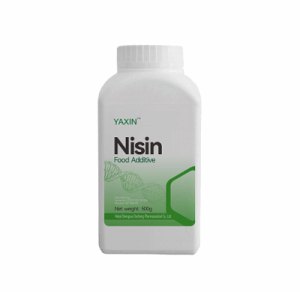
Nisin Raw Material in food products
To maximize nisin’s efficacy in food products, several factors must be considered during formulation and processing:
- Dosage: The recommended dosage of nisin ranges from1–20 IU/g (or IU/mL)depending on the food type and target bacteria. Excessive doses (above 20 IU/g) are unnecessary and may cause mild bitter off-flavors in sensitive products (e.g., milk, yogurt).
- Stability: Nisin is stable under acidic conditions (pH 2–6) but degrades rapidly at alkaline pH (>7) or high temperatures (>121°C for extended periods). For alkaline foods (e.g., some canned vegetables), it is added post-thermal processing to maintain activity. It is also stable in frozen or refrigerated storage (retaining >90% activity for 6–12 months).
- Compatibility with food components: Nisin is compatible with most food ingredients, but certain substances can reduce its activity:
- Lipids: High-fat foods (e.g., butter, fatty meats) may bind nisin, reducing its bioavailability. To mitigate this, nisin is often formulated as an oil-in-water emulsion to improve dispersion.
- Proteins: Excess proteins (e.g., in high-protein dairy products) can complex with nisin, lowering its antimicrobial activity. Adjusting the dosage (increasing by 20–30%) or using a buffered formulation (e.g., with citric acid) resolves this issue.
- Combination with other preservatives: Nisin is often used in "hurdle technology"—combining it with other preservatives (e.g., sodium lactate, potassium sorbate), processing methods (e.g., refrigeration, modified atmosphere packaging), or natural compounds (e.g., essential oils) to enhance efficacy. For example, nisin + modified atmosphere packaging (MAP, high CO₂) reducesListeriain deli meats by 5–6 log CFU/g, compared to 3–4 log CFU/g with nisin alone.
Other supplier products
|
|
Wholesale Nisin Powder |
Limited Water Solubility:Nisin is poorly soluble in water at neutral pH but dissolves more readily in acidic solutions (pH < 5) due to protonati... |
|
|
Regulatory Standards and Dosage Limits of Nisin |
Global regulatory agencies have established strict usage standards for Nisin:FAO/WHO: The acceptable daily intake (ADI) is set at 0–3300 IU/k... |
|
|
Natamycin Price,in food |
Application of natamycin in foodDairy products: In cheese, yogurt, cream and other dairy products, natamycin can inhibit the growth of mold and yea... |
|
|
Nisin Wholesale Price |
Nisin is a natural antimicrobial peptide produced by certain strains of the bacterium Lactococcus lactis.It has been widely used as a food preserva... |
|
|
High quality Nisin 500g |
Nisin is permitted for use in infant formula foods (such as in baby cheese approved by the European Union, with a limit of 0.2g /kg), and its proba... |
All supplier products
Same products