DL-Methionine

Acid-Base Properties of DL-Methionine
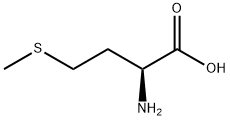
DL-Methionine is a neutral amino acid, and its acid-base behavior is derived from the amphoteric nature of the amino and carboxyl groups in its molecule.
Zwitterion formation: In aqueous solutions, DL-methionine exists primarily as a zwitterion (^+H3N-CH(R)-COO^-) via internal proton transfer from the carboxyl group to the amino group. This zwitterionic structure is the dominant form near its isoelectric point (pI=5.74), where the molecule is electrically neutral and has the lowest solubility in water.
Reaction with acids: The amino group (-NH2) can accept protons in acidic conditions, converting the zwitterion into a cationic form (^+H3N-CH(R)-COOH). For example, reacting DL-methionine with dilute hydrochloric acid produces DL-methionine hydrochloride, a salt that is highly soluble in water and suitable for the preparation of liquid formulations.
Reaction with bases: The carboxyl group (-COOH) can donate protons in alkaline conditions, transforming the zwitterion into an anionic form (H2N-CH(R)-COO^-). When DL-methionine reacts with sodium hydroxide, it forms sodium DL-methioninate, which exhibits enhanced water solubility and is widely used in the production of feed additives and nutritional supplements.
pH-dependent solubility: As a neutral amino acid, DL-methionine shows the minimum solubility at its isoelectric point (pH 5.74). In strongly acidic (pH<3) or strongly alkaline (pH>10) solutions, its solubility increases significantly due to the formation of charged ionic species, which is a key principle for its purification via acid-base precipitation.
Other supplier products
|
|
Glycine |
In the field of biological research and laboratories, glycine is one of the most commonly used biochemical reagents. It is the basic monomer for pr... |
|
|
Inositol 87-89-8 |
Inositol, also known as myo-inositol, is a six‑hydroxy cyclohexane derivative, traditionally classified as vitamin B8. It is a water‑soluble, vitam... |
|
|
Glycine |
The main physiological functions of Glycine1. Synthesis of proteinsGlycine is one of the basic units that constitute the majority of proteins and i... |
|
|
L-Methionine powder |
The sulfur-containing side chain of L-Methionine contributes to the structural integrity of keratin (the primary protein in skin, hair, and nails):... |
|
|
L-Lysine monohydrochloride |
Melting Point and Thermal Properties of L-Lysine monohydrochloride
Melting point (decomposition point): 263–264 °C (dec.). L-lysine mono... |
供应产品
Same products