

Gas pulse testing machine,High pressure gas pulsation test rig

Whats/App: +86 156 1874 6768
Web: standard-groups.com
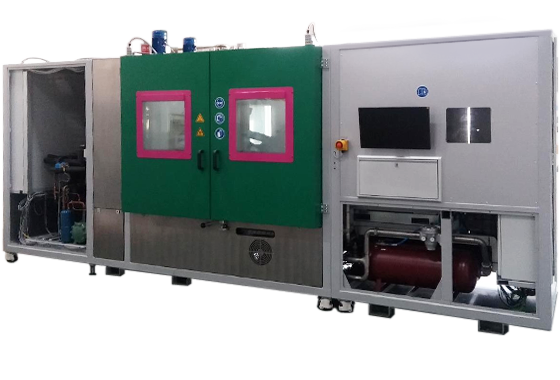
The Gas Pulse Testing Machine is a specialized system designed for evaluating automotive air-cooled and pressurized components under dynamic gas pressure conditions. You can use it to test turbocharger systems, intercoolers, and other pressurized air components with precise control. The machine provides automatic leak detection and shut-off for failed samples, while performing positive and negative pressure pulse testing to simulate real-world operational conditions.
Application
The Gas Pulse Testing Machine is suitable for a variety of automotive testing applications:
Turbocharger Components: Test air intake pipes, intercoolers, and hoses under dynamic pressure and temperature conditions.
Air-Cooled Systems: Evaluate radiators and heat exchangers subjected to pressurized air pulses.
Component Durability Testing: Conduct high-temperature pressure pulse tests to assess fatigue and long-term reliability.
Leak Detection: Automatically identify and shut down failed samples during testing.
Automotive R&D: Support material, design, and system optimization for air and turbocharged systems.
Typical test products include air intake pipes, intercoolers, turbocharger ducts, hoses, and other pressurized air system components.
Standards
The system supports compliance with major automotive engineering standards:
GMW16153. Version Oct. 2014 – GM global engineering standard for materials and component cleanliness/particle control.
TL VW60562‑2010‑06 – Volkswagen Group technical specification for system component performance and reliability.
Fiat 9.02132‑01 – Fiat engineering specification for component performance and testing requirements.
BMW 10403165‑03 – BMW group engineering specification for functional, material, and component testing.
Ford ESBB53‑6C646‑AA – Ford engineering standard for high-pressure intake pipe components.
LH 10354886‑000‑01 – LH internal standard for component durability and functional testing.
Parameters
| Parameter Category | Details |
|---|---|
| Equipment Dimensions | 4100 × 2400 × 2000 mm (W × H × D) |
| Environmental Chamber Dimensions | 1500 × 1500 × 1000 mm (W × H × D) |
| Rated Power | 35 kW |
| Test Medium | Air |
| Pressure Range | -0.5 … 5 bar |
| Pressure Frequency | > 0 … 2 Hz |
| Pressure Waveform | Trapezoidal, near Sine |
| Air Medium Temperature Range | +30 … +250°C |
| Environmental Chamber Temperature | +30 … +250°C |
| Test Channels | 8 |
| Motion Device Frequency | > 0 … 2 Hz |
| Motion Device Amplitude | max. ±30 mm |
Features
Designed for testing automotive motor parts, particularly turbocharger pipelines.
Performs high-temperature pressure pulse testing under hot air conditions.
Equipped with a large environmental chamber for sample placement.
Pressure range from -0.5 to max. 5 bar.
Automatic leak detection and leak testing with fail-safe shutdown for defective samples.
Integrated robot for 3D motion simulation of test samples.
Windows-based control unit with real-time data recording.
Accessories
Environmental chamber with dual access doors
Linear and 3D robotic motion system
Pressure sensors and leak detection units
Air supply system with temperature and pressure control
Windows-based control and data acquisition software
Safety interlocks for failed samples
Sample mounting brackets for turbocharger components
Test Procedures
Ensure the test area is safe and allows full access to all test channels.
Connect the system to a 35 kW power supply.
Supply pressurized air to the chamber and confirm temperature control settings (+30 to +250°C).
Mount the turbocharger, intercooler, or air-cooled system component in the environmental chamber.
Start the Windows control system and set pressure pulse range, waveform, frequency, and amplitude.
Activate the robotic 3D motion system to simulate operational stresses.
Monitor air pressure, temperature, and leak detection sensors during testing.
Automatically shut down any failed samples.
Record all test data for compliance and durability analysis.
After testing, allow the system to cool before removing samples.
Maintenance Information
Inspect motion devices, robotic arms, and pressure sensors before each test.
Verify air supply, tubing, and chamber seals for leaks.
Periodically calibrate pressure, temperature, and motion sensors.
Clean the environmental chamber and robotic components to prevent contamination.
Replace worn or damaged safety devices to maintain operational integrity.
在线联系供应商
Other supplier products
 |
Laboratory Electrospinning Device for Nanofiber Membrane Fabrication | Get a quote: Whats/App: +86 156 1874 6768 Web: standard-groups.com Standard T/YNIA 017-2023 "Electrospun Nonwoven Air Filter Materials" Techni... |
 |
Safety Helmet Chin-strap Strength Tester | Whats/App: +86 156 1874 6768 Web: standard-groups.com The Safety Helmet Chin-strap Strength Tester is designed to evaluate the tensile strength a... |
 |
Photography Testing Light Chamber | Whats/App: +86 156 1874 6768 Web: standard-groups.com Standard ISO 12233: Compliant with SFR (Spatial Frequency Response) testing for lens resol... |
 |
20L Spherical Explosion Tester | Whats/App: +86 156 1874 6768 Web: standard-groups.com Product Description: 20L Spherical Explosion Tester is characterized by accurate test data... |
 |
OEM Footwear Testing Equipment Manufacturer | Get a quote: Whats/App: +86 156 1874 6768 Web: standard-groups.com Applications (1)Testing the peeling strength of athletic shoes, safety shoes... |
Same products
 |
ER4047 Aluminum Mig Welding Wire | 卖方: 868776 | Hangzhou Kunli Welding Materials Co., Ltd. specializes in manufacturing reliable welding material... |
 |
ER4043 Silicon Aluminum Welding Wire | 卖方: 868776 | Hangzhou Kunli Welding Materials Co., Ltd. specializes in manufacturing high-quality welding mate... |
 |
Choosing the Right Equipment for Heavy-Duty Cleaning | 卖方: Taizhou Feike Mechanical Technology Co., Ltd. | FEIKE’s High Pressure Washer is designed for industrial cleaning, equipment maintenance, ve... |
 |
ER4043 Silicon Aluminum Welding Wire | 卖方: 868776 | Hangzhou Kunli Welding Materials Co., Ltd. offers ER4043 Silicon Aluminum Welding Wire for alumin... |
 |
HDPE高速水冷双壁波纹管生产线 | 卖方: Shandong HUASU Plastic Technology Co.,Ltd. | 机头模具采用双流道结构、氮化磨光处理机头,偏壁调整方便快捷,保证内外层壁厚均匀和稳定成型。 最新设计密闭压力水冷冷却结构,冷却充分,多点分布真空系统,效率更高,生产速度更快。 双层在线扩口功... |

