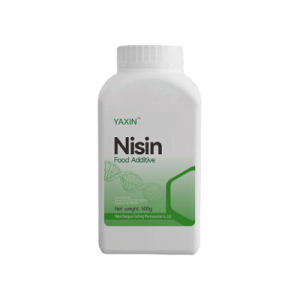
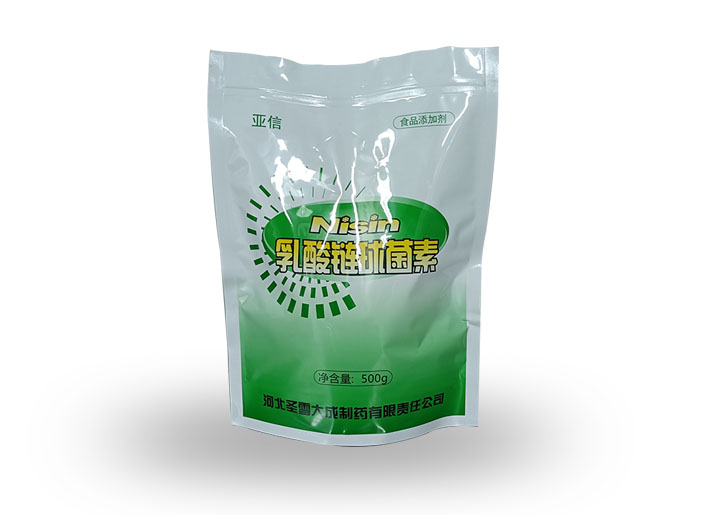
Nisin 500g

The antibacterial mechanism of Nisin (Nisin) is the core for its function as a natural polypeptide preservative. It is mainly achieved through multiple pathways such as specific destruction of bacterial cell membranes, interference with cell wall synthesis, and induction of autolysis. The specific mechanisms are as follows:
I. Cell membrane targeting effect: Disrupting the integrity of bacterial membranes
Insert into the cell membrane to form pores
The molecular structure of Nisin contains five special sulfide rings (rings A, B, C, D, and E), endowing it with both hydrophobic and hydrophilic bipolarity. When in contact with the cell membranes of Gram-positive bacteria (such as Staphylococcus aureus and Listeria), the hydrophobic end is inserted into the lipid layer of the cell membrane, while the hydrophilic end is exposed extracellular, and then aggregates into oligomers, forming transmembrane channels with a diameter of approximately 1-2 nm on the cell membrane.
The formation of pores leads to a sharp increase in the permeability of the cell membrane, and important substances such as intracellular potassium ions (K⁺), ATP, and amino acids leak rapidly, eventually causing the death of bacteria due to energy exhaustion and osmotic pressure imbalance.
Interfere with membrane potential and energy metabolism
The formation of pores disrupts the proton gradient (H⁺ concentration difference) and membrane potential of the cell membrane, inhibits the oxidative phosphorylation process of bacteria, prevents them from synthesizing ATP, and thereby blocks the energy supply. Studies have shown that after the action of Nisin, the intracellular ATP level of bacteria can decrease by more than 90% within several minutes.
2. Inhibiting cell wall synthesis: Blocking the assembly of peptidoglycan
Target Lipid II
Lipid II is a key intermediate carrier for the synthesis of peptidoglycan in the cell wall of Gram-positive bacteria, responsible for transporting peptidoglycan precursors outside the cell membrane. The C-terminal domain of Nisin can bind to the pyrophosphate group of lipid II with high affinity, forming the "Nisin-lipid II" complex.
This complex competitively inhibits the activity of glycosyltransferase, blocks the extension and cross-linking of peptidoglycan chains, leads to the obstruction of cell wall synthesis, and causes bacteria to lyse due to cell wall defects.
Synergistically enhance the membrane destruction effect
The combination of lipid II and Nisin not only inhibits the synthesis of the cell wall, but also promotes the aggregation of Nisin on the cell membrane, further enhancing the efficiency of pore formation. This "double strike" mechanism makes the antibacterial activity of Nisin significantly higher than that of single-acting preservatives.
Iii. Inducing bacterial autolysis: Activating the autolysis enzyme system
Nisin can induce bacteria to express or activate their own autolysis enzymes (such as peptidoglycan hydrolase), accelerating the degradation of the cell wall. For example, in Streptococcus pneumoniae, Nisin can promote the release and activity of the autolysis enzyme LytA from the cell membrane, leading to the self-decomposition of the bacteria.
This mechanism is particularly obvious at low concentrations of Nisin (sub-inhibitory concentration). Although it does not directly kill bacteria, it can inhibit their growth and reproduction.
Iv. Specificity of Mechanism of Action: Why Only Target Gram-positive Bacteria?
Structural susceptibility of Gram-positive bacteria
The cell wall of Gram-positive bacteria is relatively thick (about 20-80 nm) and contains a large amount of peptidoglycan (accounting for 50%-90% of the dry weight of the cell wall). The phosphoeptic acid on its surface can serve as the initial binding site of Nisin, helping Nisin approach the cell membrane.
The outer membrane of the cell wall of Gram-negative bacteria contains lipopolysaccharide (LPS), forming a physical barrier that prevents Nisin from coming into contact with the cell membrane. Therefore, the direct effect of Nisin on it is relatively weak (but it can exert its effect after being compounded with chelating agents such as EDTA and destroying the integrity of the outer membrane).
The differences from human cells
The cell membranes of human cells (such as animal cells) are composed of phospholipid bilayer and cholesterol, without peptidoglycan or lipid II. Nisin cannot bind to them and thus is non-toxic to human cells. This is also an important basis for the safety of Nisin.
V. Dynamic Process of Antibacterial Mechanism: Sequential Changes from Binding to Sterilization
Rapid binding stage (second level) : Nisin binds to phosphoeptic acid on the bacterial surface through electrostatic interaction and locates near the cell membrane.
Membrane pore formation stage (minute level) : Nisin inserts into the cell membrane, oligomerizes to form pores, leading to the leakage of small molecule substances.
Energy depletion and death stage (minutes to hours) : ATP synthesis is blocked, intracellular substances are continuously lost, bacterial metabolism collapses, and eventually death occurs.
Other supplier products
|
|
Natamycin |
Natamycin, being a sensitive and specialized compound, requires careful handling and storage during transportation to maintain its stability and ef... |
|
|
Nisin Raw Material Price |
Nisin(Lactic acid streptococcin), as a biological preservative, holds extensive application prospects in meat products. It not only effectively inh... |
|
|
Nisin Supplier |
Storage in Dry Form:When stored as a dry powder, nisin is less sensitive to pH fluctuations, but exposure to moisture in alkaline environments can ... |
|
|
Natamycin |
Natamycin is a polyene macrolide antifungal compound produced by the fermentation of Streptomyces.In 1955, Struyk et al. isolated this substance fr... |
|
|
Oxytetracycline Hydrochloride Soluble Powder 50% 200g |
Oxytetracycline Hydrochloride Soluble Powder is a broad-spectrum antibiotic used to treat a variety of bacterial infections in animals. It is a der... |
供应产品
Same products