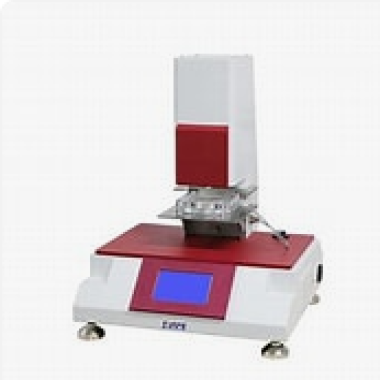
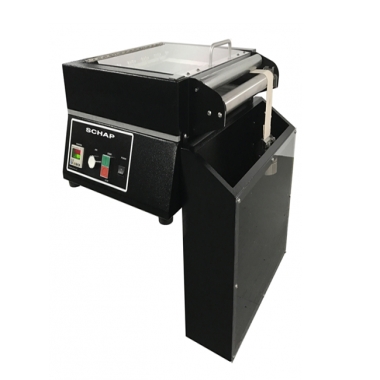
Fabric liquid penetration tester

Main Parameters
1. The penetrating disc is made of special organic glass through special processing, ensuring a weight of 500 grams ± 5 grams.
2. Large-capacity burette, greater than 100 ml.
3. Moving stroke of the burette: 0.1 - 150 mm.
4. Moving speed of the burette: approximately 50 - 200 mm/min.
5. Liquid flow rate: controlled to pass through 80 ml within 6 seconds, with an error less than 2 ml.
Main Features
1. The whole machine is processed with high-quality metal spray paint.
2. The specimen platform is made of imported special aluminum profiles, featuring light weight, smooth surface, and rust resistance.
3. Made of imported special aluminum brushed panel with metal buttons.
4. Equipped with an imported meter head.
5. The penetrating disc is equipped with a precision positioning device.
6. The specimen clamping can directly lift the penetrating disc and is equipped with positioning and fixing devices.
7. The electrode of the penetrating disc is made of special platinum wire material.
8. The penetrating disc is equipped with a quick connection interface, which can conveniently replace additional penetrating discs.
9. The liquid release is equipped with an automatic release device, enabling automatic control.
Test Procedure
1. Place the liquid penetration tester on a stable test bench and adjust the instrument to be level, making the whole instrument as horizontal as possible. Connect the power cord at the back of the box to the power socket and connect the grounding wire to the grounding terminal on the back of the box. Connect the plug of the penetrating disc electrode to signal connector 1 on the instrument control box and the plug of the solenoid valve to signal connector 2. After preparing the instrument, turn on the power switch on the instrument panel.
2. Prepare the consumables for the test, such as experimental liquid (simulated urine), test samples, absorbent paper for testing, etc.
3. **Step 1**: Cut a specimen of 125 mm × 125 mm and condition it according to the standard requirements. Place the standard absorbent pad and the specimen from bottom to top in the specimen positioning disc (the side of the specimen that contacts the skin facing up).
4. **Step 2**: Loosen the funnel positioning screw, adjust the height of the funnel so that the distance between the nozzle of the funnel and the top surface of the specimen is 30 mm, and then tighten the positioning screw.
5. **Step 3**: Place the penetrating disc on the specimen (ensure that the penetrating disc is clean to avoid affecting the test results), and make sure that the center of each disc is concentric with the center of the funnel during the placement process.
6. **Step 4**: Use a syringe to draw 5 ml of liquid and drop it into the funnel. Press the start switch button on the panel, and the solenoid valve of the funnel opens, allowing the liquid to flow into the circular cavity of the penetrating disc.
7. **Step 5**: After the liquid flows into the circular cavity of the penetrating disc, connect the electrode. The timer automatically starts timing. When all the liquid seeps into the standard absorbent pad and the liquid level drops below the electrode, the two electrodes are disconnected, and the timer stops timing. Read the time recorded by the timer, which is the penetration time.
8. **Step 6**: Replace the standard absorbent pad and the specimen, and repeat steps 4 - 10 of the determination of the liquid penetration time until all specimens are tested.
9. **Step 7**: After the determination of the liquid penetration time (simulated urine) for the entire test is completed, promptly clean up the liquid in the positioning disc and turn off the power.
10. After the experiment, be sure to clean the instrument and carefully wash the experimental funnel, pipeline, load platform and other key components with clean water to ensure the accuracy of the instrument.
Other supplier products
|
|
Flash Measurement Instrument |
Product Introduction:
VMO series flash measuring instrument is mainly used to measure the plane size, such as precision workpiece, stamping parts,... |
|
|
Car seat static strength tester |
Applicable standards:
GB 11550-2009"Car seat headrest strength requirements and test methods" : This standard specifies the static strength test r... |
|
|
MARK-II Slip Resistance Tester |
Product Introduction:
Paste the cut sample on the test fixture of the portable MARK-II anti-slip testing machine, put down the weight of the rotat... |
|
|
Seat Belt Abrasion Tester-QINSUN |
Standard:
ISO 10555(Seat Belt Assemblies - Test Methods for Abrasion Resistance)
ECE R16(Uniform Provisions Concerning the Approval of Safety B... |
|
|
Semi-automatic tank cleaning system for IBC |
Main Functions:
Interior cleaning of IBC totes
The interior of a container is cleaned using a rotating cleaning head. The cleaning head is insert... |
供应产品
Same products