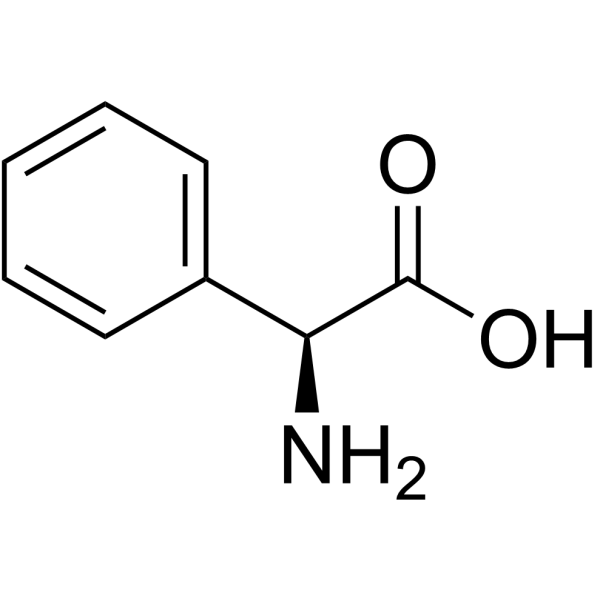
DL-Alanine
The defining feature of a direct food preservative is its ability to target and inhibit the metabolic processes or structural integrity of microorganisms (e.g., disrupting bacterial cell membranes, inhibiting enzyme activity for mold growth). DL-Alanine, as an α-amino acid, does not possess this targeted antimicrobial effect:
- It cannot directly kill or suppress the growth of common food spoilage microorganisms (e.g.,Bacillus subtilis,Aspergillus niger,Saccharomyces cerevisiae) at the low addition levels typically used in food (0.1%–1%, far below concentrations that might have weak antimicrobial effects).
- Unlike Nisin (which targets Gram-positive bacteria) or sodium benzoate (which disrupts microbial acid-base balance), DL-Alanine does not interfere with microbial physiology under normal food processing and storage conditions.
Другие товары поставщика
|
|
Key Notes on Applications of L-Methionine |
Key Notes on Applications of L-Methionine Purity Requirements: Food-grade and pharmaceutical-grade L-Methionine require high purity (≥98%) to en... |
|
|
Purchase price |
As an amphoteric compound, L-threonine can buffer pH changes in acidic or alkaline food systems: Used in beverages (e.g., sports drinks, fruit juic... |
|
|
L-Glutamine |
L-Glutamine, also known as L-glutamine or L-2-aminopentanedioic acid amide, is an organic compound with the molecular formula C5H10N2O3 and a molec... |
|
|
L-proline |
Storage and transportation of L-prolineStorage conditions: Store in a sealed container in a cool and dry place, away from moisture, high temperatur... |
|
|
L-Phenylalanine |
L-Phenylalanine is an essential amino acid with significant biological functions and various applications. Here is a detailed account:
Basic Inform... |
Все товары поставщика
Похожие товары