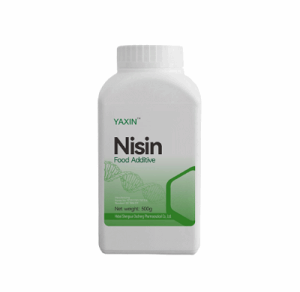
Nisin

Nisin’s stability is significantly affected by interactions with food components, which alter its free concentration and ability to reach bacterial targets—directly impacting antimicrobial performance.
Protein/fat binding: In high-protein (e.g., meat, dairy) or high-fat (e.g., cheese, salad dressings) foods, nisin binds to proteins (e.g., casein) or fat globules via hydrophobic and electrostatic interactions. This reduces the free nisin concentration available to act on bacteria, weakening efficacy. For example, in full-fat milk, the effective free nisin concentration is 30–40% lower than in skim milk, requiring a 10–20% higher addition level to achieve the same antimicrobial effect.
Ion-induced stabilization/inactivation: Divalent cations (Ca²⁺, Mg²⁺) stabilize nisin’s structure by forming complexes with its carboxyl groups, enhancing heat resistance and extending activity retention. Conversely, transition metals (Fe³⁺, Cu²⁺) or reducing agents (e.g., mercaptoethanol) catalyze oxidative degradation or cross-link cleavage, reducing efficacy. Compounding nisin with EDTA (a chelating agent) mitigates metal ion-induced inactivation, preserving antimicrobial activity.
Sugar/preservative interactions: High sugar concentrations (e.g., in syrups or confectionery) may reduce nisin solubility and diffusion, slightly lowering efficacy. However, nisin exhibits synergistic stability with organic acids (e.g., lactic acid) and plant extracts (e.g., tea polyphenols), which not only enhance its stability but also broaden its antimicrobial spectrum (e.g., inhibiting Gram-negative bacteria when combined with EDTA).
Other supplier products
|
|
Nisin |
Nisin is a naturally occurring antimicrobial peptide produced by certain strains of lactic acid bacteria, primarily Lactococcus lactis.It is common... |
|
|
Sulfachloropyrazine Sodium Soluble Powder 30% 500g |
Trade Name: Shengxue QiulingCommon Name: Sulfachloropyrazine Sodium Soluble PowderMain Ingredients: Sulfachloropyrazine SodiumDescription: This pro... |
|
|
Nisin |
Nisin is a natural antimicrobial peptide produced by certain strains of the bacterium Lactococcus lactis.It has been widely used as a food preserva... |
|
|
Safety Considerations in Practical Applications of Nisin |
Dosage Control: Excessive addition (>0.5 g/kg) not only increases production costs but may also cause slight bitterness in foods (e.g., dairy pr... |
|
|
Natamycin |
New products coming soon!Welcome to inquire and book!
Natamycin is a natural antifungal agent and antibiotic that belongs to the polyene macrolide ... |
供应产品
Same products