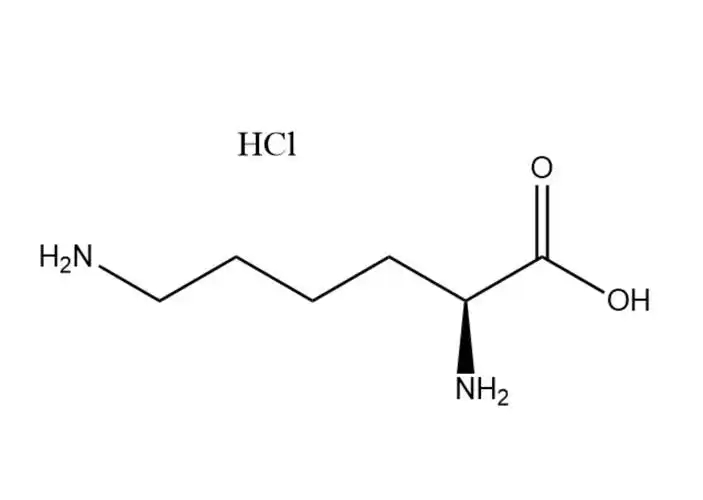
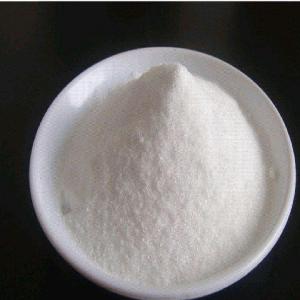
L-Lysine monohydrochloride
Solubility ofL-Lysine monohydrochloride
Solubility is the most distinctive physical property of L-lysine monohydrochloride, and its high aqueous solubility is the primary reason for its industrial dominance over free L-lysine. All solubility data are at 25 °C (ambient temperature) unless specified:
- Water: Highly soluble— solubility of ~70 g/100 mL (free L-lysine: ~63 g/100 mL). Solubility increases with temperature (e.g., ~90 g/100 mL at 40 °C, ~110 g/100 mL at 60 °C). Dissolution is endothermic (a small temperature drop occurs during dissolution) and rapid, with no precipitation in dilute to concentrated aqueous solutions (up to 60% w/v).
- Aqueous polar solvents: Soluble in methanol (~1 g/100 mL) and ethanol (~0.1 g/100 mL); slightly soluble in propylene glycol and glycerol (common food/ pharmaceutical excipients).
- Non-polar organic solvents: Insoluble in acetone, ether, chloroform, benzene, and hexane— consistent with its ionic salt nature (zwitterion + Cl⁻) and high polarity.
- Buffer solutions: Soluble in all common aqueous buffers (phosphate, citrate, Tris-HCl) over a pH range of 2.0–12.0, with no precipitation or chemical reaction— suitable for biological and pharmaceutical assay formulation.
Other supplier products
|
|
Sucralose |
Sucralose is also known as Trisodium Phosphate. It is a powerful food sweetener, with the trade name Splenda and the abbreviation TGS.Sucralose is ... |
|
|
DL-Methionine |
DL-Methionine has multiple coordination sites (amino nitrogen, carboxylate oxygen, and sulfur atom in the methylthio group), enabling it to form st... |
|
|
L-Cysteine hydrochloride monohydrate |
Chemical Structure and PropertiesMolecular FormulaChemical Formula:C3H7NO2S· HCl· H2O Molecular Weight: Approximately 175.64 g/molStr... |
|
|
Main Applications of Inositol |
Main Applications of Inositol 1. Health food and nutritional supplements As a vital nutrient, inositol regulates lipid metabolism, protects the liv... |
|
|
Chemical Properties of Inositol |
Chemical Properties of Inositol 1. Molecular structure and isomerism Inositol is a cyclic hexahydric alcohol with the molecular formula C6H12O6, co... |
供应产品
Same products